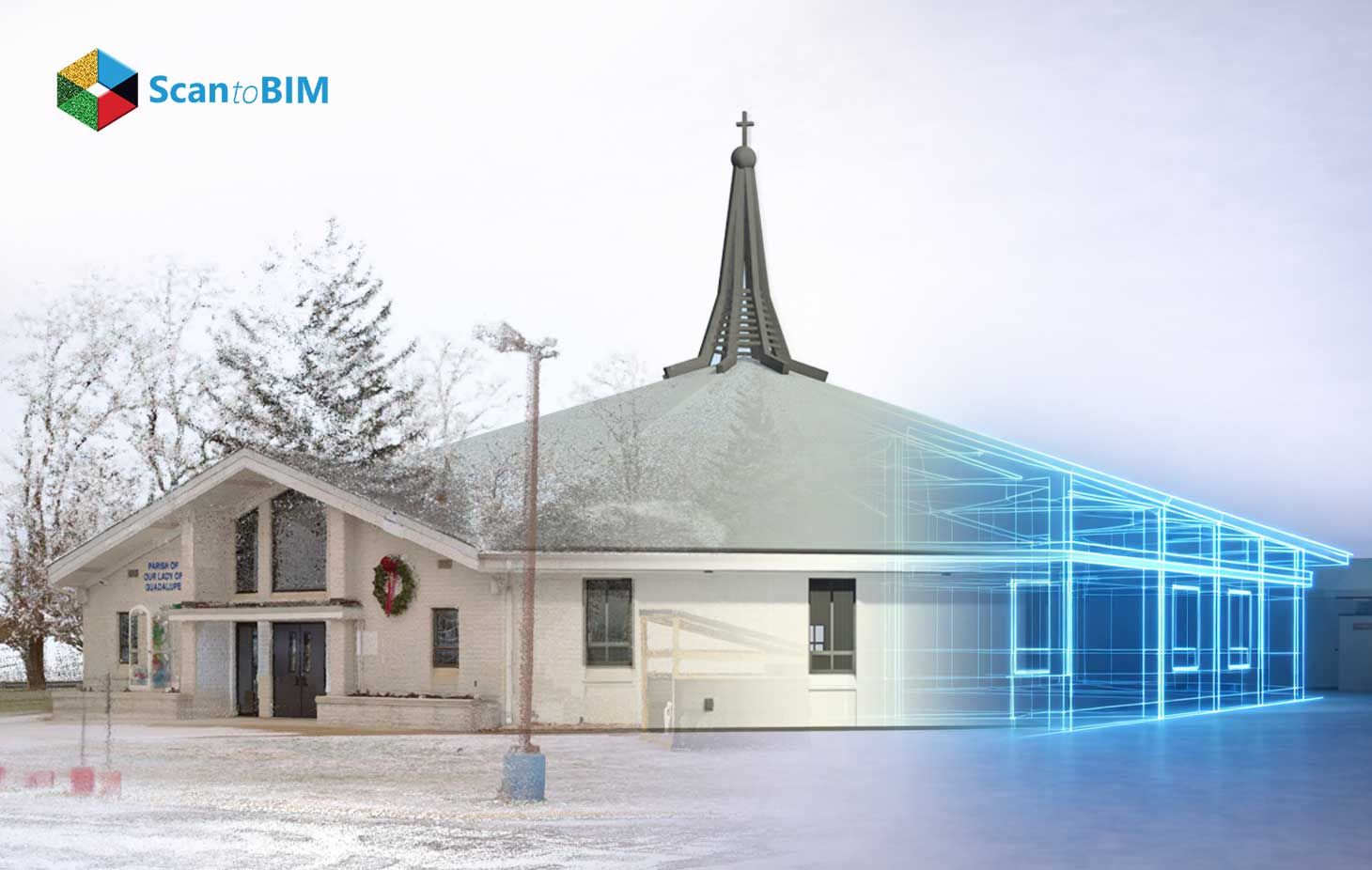
Manual site documentation is slow, error-prone, and expensive. Coordination conflicts, outdated as-built records, and weeks lost to manual point cloud processing continue to drain project budgets and delay delivery. AI-powered Scan to BIM solves this by bringing intelligence, speed, and precision to the entire digital construction workflow.
Digital construction ecosystems connect reality capture, BIM platforms, IoT networks, and analytics into a unified lifecycle framework. Project teams capture highly detailed site data, integrate it into coordinated BIM environments, and drive design, fabrication, and operational decisions through shared digital models across disciplines.
Building Information Modeling acts as the central intelligence layer that fuses geometry, metadata, and process logic into a coordinated environment. Artificial intelligence amplifies this framework by processing large-scale datasets and generating actionable insights that guide architectural planning, multidisciplinary coordination, and lifecycle performance strategies.
- Deep Learning: Processes unstructured visual data like site photographs, thermal images, and 3D scans, to detect anomalies invisible to manual review
- Computer Vision: Analyzes spatial relationships and construction progress within live site environments for automated quality assurance.
- Machine Learning: Trains on historical project datasets to generate predictive scheduling, cost forecasting, and risk models
AI systems process massive volumes of point clouds, drawings, sensor streams, and historical records to extract patterns that guide decision-making. Within digital construction technology, these systems classify geometry, evaluate clashes, detect anomalies, and prioritize coordination issues. This allows project teams to act with speed and precision across complex building environments.
Digital twin model platforms connect BIM models with live IoT data streams and deliver continuous performance insights. Architectural teams use this intelligence to accelerate iterative design cycles and refine coordination strategies. AI operates as a design copilot that enhances feedback loops and drives performance-focused project outcomes.
By the end of this blog, you will understand how AI-powered Scan to BIM works, where it delivers the most value, what challenges to expect, and where the technology is headed next.
What Is AI-Powered Scan to BIM?
AI-powered Scan to BIM combines 3D reality capture methods, LiDAR, laser scanning, and photogrammetry with advanced computer vision pipelines that interpret raw point clouds. These instruments generate dense point sets representing surfaces, edges, and geometry across entire facilities, including interiors, facades, structural systems, and MEP networks. AI models ingest this point cloud data and classify it into semantic categories that align with BIM object libraries such as walls, slabs, columns, ducts, and equipment across the full facility scope.
Neural networks in an AI-powered scan to BIM workflow detect geometric primitives, planes, cylinders, and extrusions. Then group them into parametric elements following BIM standards. Deep learning segmentation models separate architectural, structural and MEP regions at scale, feeding rule components that generate objects with parametric relationships including wall thickness and spatial alignment.
- Automatic recognition of geometric primitives, classifying planar surfaces as walls, floor slabs, ceilings, and roof planes
- Parametric element detection for doors, windows, structural columns, beams, and MEP components directly from raw point cloud input
- Material classification using spectral reflectance analysis and surface texture recognition within the scan data
- Geometric relationship validation cross-checked against architectural logic rules embedded in the model training framework
AI-driven conversion achieves up to 95% accuracy in LiDAR-enabled 3D scan to BIM model generation. A rate that repositions the economic case for digital documentation of existing buildings at scale across renovation, expansion, and portfolio-wide digitalization programs.
How AI Improves Point Cloud to BIM Workflows
AI transforms scan modeling by introducing intelligent pipelines that automate feature extraction, segmentation, and classification across entire datasets. Within this transformation Point cloud to BIM automation processes millions of spatial data points simultaneously, identifies geometric primitives, and converts them into structured BIM elements. This accelerates model generation and elevates consistency across architectural, structural, and MEPF domains.
AI extends its capabilities through pattern recognition and adaptive learning across project datasets. AI in BIM modeling applies learned geometric logic to infer missing elements, resolve occlusions, and generate parametric objects with embedded attributes. These systemscontinuously refine outputs based on historical data, which improves modeling precision and supports scalable workflows across complex environments.
These segmentation pipelines classify point clouds into distinct categories such as structural systems, architectural components, and MEP infrastructure. These systems perform voxelization, clustering, and object fitting to transform raw data into BIM-ready geometry. Validation engines compare generated models against source scans and flag deviations beyond tolerance thresholds. Advanced detection models achieve over 92% accuracy in identifying clashes and safety-related conflicts.
Further compresses production timelines by integrating real-time validation, automated error detection, and interoperability with BIM standards such as IFC. Continuous comparison between scan data and generated models improves geometric fidelity and coordination quality. These capabilities reduce modeling durations from weeks to days and enable BIM teams to focus on high-value design decisions and coordination strategies.
Role of AI in Architectural Design and Planning
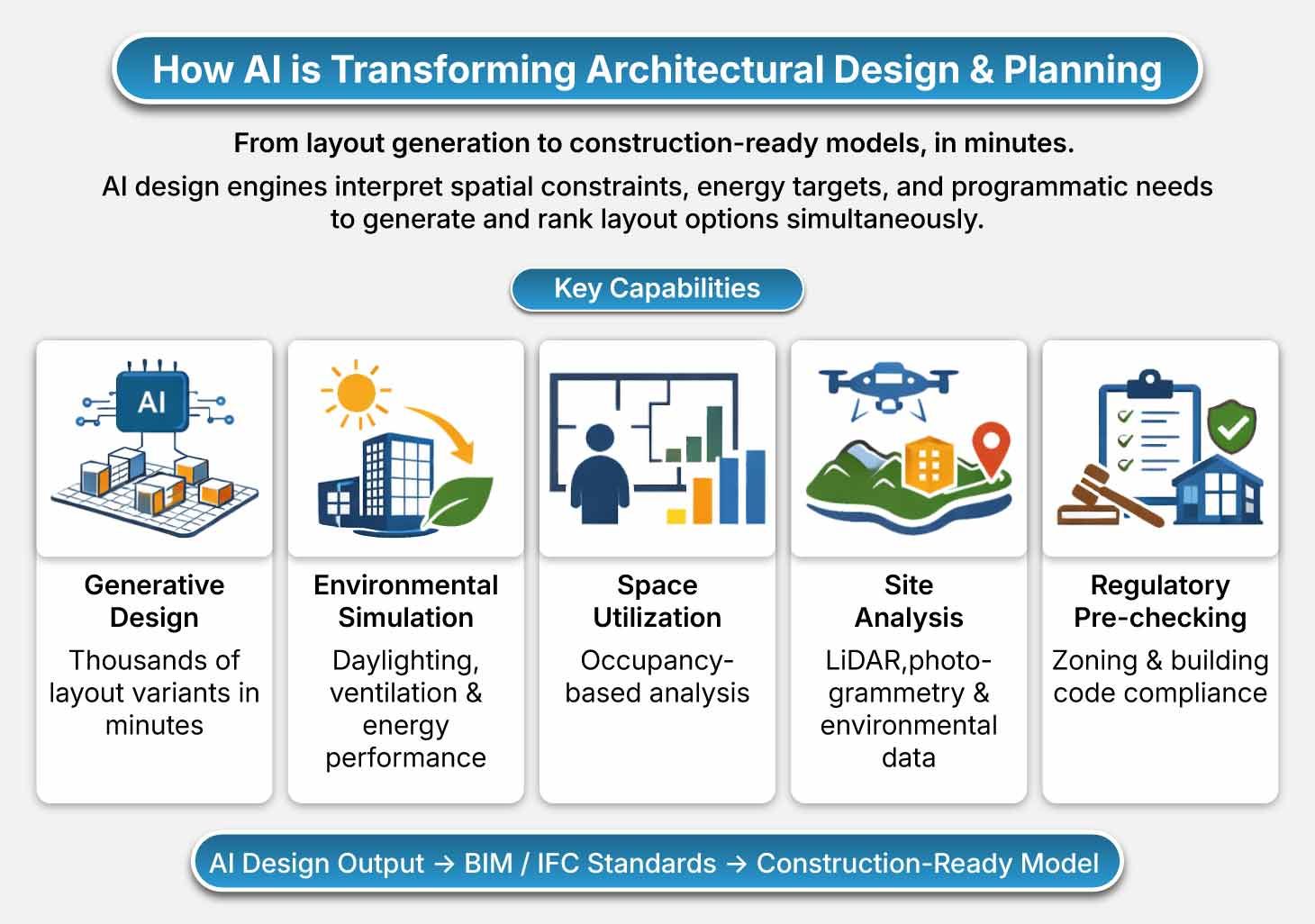
AI design engines interpret spatial constraints, adjacency requirements, programmatic needs, and energy targets. Then generate layout options that align with those parameters simultaneously. Generative design tools scan boundary conditions, irregular floor plates, existing core positions, and structural grid alignments as fixed inputs for new floorplan alternatives. Architects configure target area ratios, daylight access requirements, and circulation efficiency thresholds, and the platform proposes ranked design variants scored against every objective within minutes of project initiation.
Computational throughput in AI for architectural design platforms delivers measurable value from the earliest project phase, precisely where design choices carry the greatest downstream impact on cost, performance, and constructability. As per generative design research, AI‑driven optimization models have demonstrated cost reductions between 2.7% and 17%, achieved through optimized structural configurations and improved spatial efficiency. Architects redirect professional expertise toward evaluating and contextualizing algorithmically generated options.
- Generative design producing thousands of layout variations within minutes
- Environmental simulation for daylighting, ventilation, and energy performance
- Space utilization analysis based on occupancy and functional requirements
- Site analysis using LiDAR, photogrammetry, and environmental datasets
- Regulatory pre-checking aligned with zoning and building code parameters
Integration of AI outputs with BIM standards, IFC data structures, and BCF coordination workflows keeps every AI-generated design variant measurable, interoperable, and construction-ready from day one. Digital twins further support planning by delivering real-time operational feedback that architects apply directly to refine future designs.
Benefits of AI-Driven Scan to BIM Technology
AI-driven Laser scan to Revit technology improves accuracy, accelerates modeling cycles, and improves decision quality across architectural workflows. As-Built BIM modeling captures highly precise geometry, material data, and system relationships that support accurate coordination, prefabrication, and lifecycle analysis. This directly improves project performance and long-term asset value.
Speed and Time Efficiency
AI pipelines process large-scale scan datasets rapidly and convert them into BIM models within days, which accelerates project initiation and supports faster delivery across renovation and construction workflows.
High Geometric Accuracy
AI-driven modeling achieves up to 95% accuracy in geometry reconstruction, which improves coordination quality and reduces discrepancies during design development and construction phases.
Cost Efficiency and ROI
Reduced manual modeling effort and fewer coordination issues lower project costs, which improves return on investment across design-build and integrated project delivery methods.
Task Automation
Automated feature recognition and segmentation allow BIM professionals to focus on model validation, detailing, and data enrichment, which increases productivity and technical output quality.
Coordination Quality
Architectural, structural, and MEP elements enable immediate clash detection and multidisciplinary coordination, which improves collaboration and reduces design conflicts.
Sustainability Performance
AI-driven optimization supports material efficiency and reduces waste generation, and industry studies report energy savings in the 20–30% range through optimized building performance.
Lifecycle Integration
Detailed BIM models integrate with digital twins and facility management systems. This supports predictive maintenance, asset tracking, and long-term operational efficiency.
Applications of AI in Renovation and Existing Building Projects
Renovation and asset repositioning projects require an accurate representation of existing conditions to guide design decisions. In this context, Scan to BIM services capture interiors, structural systems, and service networks, then convert them into as-built BIM environments that support reconfiguration, retrofits, and adaptive reuse strategies across complex building scenarios with high spatial fidelity.
Heritage preservation projects involve complex geometries and intricate architectural elements that demand advanced interpretation. Intelligent segmentation techniques analyze curvature, point density, and surface continuity to reconstruct vaulted ceilings, ornamental facades, and historic masonry, which enables precise conservation planning and detailed digital documentation.
Retrofitting workflows benefit from integration between BIM models and structural or energy analysis tools. Data-driven simulations evaluate HVAC performance, envelope conditions, and system efficiency. Predictive maintenance models connected with digital twins achieve failure prediction accuracy of up to 87%. This improves asset performance and operational continuity across building portfolios.
These workflows extend beyond documentation and contribute to lifecycle intelligence through performance monitoring, system optimization, and informed decision-making, which supports resilient and efficient built environments.
Key Applications Overview
| Application Area | Capability | Outcome |
|---|---|---|
| Renovation Planning | Automated as-built model generation and condition assessment | Accurate retrofit strategies and design alignment |
| Heritage Preservation | Irregular geometry processing and material classification | Precise conservation and restoration planning |
| Facility Management | Integration with IoT-enabled digital twins | Real-time monitoring and predictive maintenance |
| Energy Optimization | Simulation of building performance | Improved HVAC efficiency and reduced energy consumption |
| Structural Analysis | Evaluation of load conditions and structural integrity | Safer adaptive reuse and structural upgrades |
| MEP System Upgrades | Clash detection and routing optimization | Efficient system redesign and coordination |
| Safety Compliance | Validation against regulatory requirements | Faster approvals and improved compliance documentation |
Challenges in AI-Based BIM Automation
AI-based BIM automation introduces complex technical and organizational constraints that influence implementation strategies across project environments. Here, scan to BIM challenges emerge from data quality variations, processing requirements, interoperability limitations, and governance considerations. These require structured workflows, controlled data inputs, and continuous validation to maintain accuracy and consistency in automated model generation.
Technical Challenges
Data Noise and Occlusions
Raw point cloud datasets contain noise from reflective surfaces, moving objects, and scanning limitations. Occlusions caused by furniture or restricted visibility create missing geometry. AI models infer these gaps through learned patterns, and BIM specialists review outputs to validate accuracy and alignment with project requirements.
Proprietary File Format Complexity
Scan data arrives in multiple formats, such as .rcp, .e57, .pts, and .las, each with distinct data structures. Processing these formats requires conversion pipelines that preserve geometry and metadata, which increases workflow complexity across multi-scanner and multi-platform project environments.
Computational Infrastructure Requirements
AI-driven BIM workflows demand high-performance computing environments supported by GPU acceleration and scalable cloud storage. Large datasets require efficient processing pipelines, and organizations invest in infrastructure that supports real time analysis, model generation, and continuous data validation across complex projects.
Interoperability and Data Standardization
BIM platforms store geometry and metadata using different schemas, which creates challenges during data exchange. IFC and BCF standards support interoperability, and teams manage schema consistency to maintain object intelligence and relationships across software ecosystems and coordination platforms.
Operational and Ethical Challenges
Human Verification Requirements
Automated outputs undergo expert validation to confirm structural logic, compliance requirements, and project-specific accuracy. Human oversight maintains quality and aligns AI-generated models with professional standards.
Explain the Ability And Transparency
Deep learning systems operate through complex computational processes that require interpretability. Explainable AI frameworks provide visibility into model decisions, confidence levels, and classification logic for BIM managers.
Data Privacy and Security Compliance
Point cloud datasets often include sensitive building information. Data governance frameworks address storage, processing, and regulatory compliance requirements, including GDPR considerations for international projects.
Liability and Governance Frameworks
AI-generated outputs introduce questions around accountability and responsibility. Organizations define governance protocols and validation processes to manage risk and maintain clarity in decision-making across project stakeholders.
Future of AI and Digital Construction Technology
Point Cloud to BIM services will operate within a radically more connected infrastructure ecosystem as this decade advances. The convergence of 5G connectivity, edge computing platforms, and AI-powered autonomous scanning systems will create Point cloud to Revit model pipelines. That captures, processes, and delivers updated BIM models in near real time from active construction sites without requiring human operators to initiate or supervise the process.
The scale of this transition already appears in forward projections. AI adoption across construction projects will grow from approximately 15% in 2024 to an estimated 60–70% by 2030, with digital twin deployments covering up to 80% of new commercial buildings within the same timeframe.
The scan to BIM workflow of 2030 and beyond will incorporate technologies currently at the leading edge of research and early deployment.
- Autonomous Drone Scanning: UAV platforms executing programmatic scan missions across active construction sites and transmitting point cloud data directly to cloud AI processing environments with zero manual intervention
- Real Time Model Updating: AI engines are refreshing BIM models continuously as construction progresses, maintaining live as-built accuracy against the current field condition
- 5G Enabled Site Coordination: Instantaneous data transmission between field scanning platforms and remote design and engineering teams, collapsing the feedback loop between field conditions and design decisions from days to minutes
- AR/VR Integration: Mixed reality environments where architects and engineers walk through AI-generated BIM models overlaid on physical site conditions through head-mounted display systems
- Predictive Supply Chain Intelligence: AI systems forecasting material performance degradation, logistics bottlenecks, and procurement lead times through simulation of real-world project conditions modeled within BIM
Open BIM standards IFC and BCF will serve as the governance layer enabling interoperability across this heterogeneous technology ecosystem. Explainable AI frameworks will satisfy emerging regulatory requirements for AI-generated documentation transparency and professional liability attribution.
Conclusion
AI-powered as-built modeling has redefined architectural documentation through an integrated scan to BIM workflow that begins with reality capture and advances into data-rich building intelligence. Intelligent models interpret point clouds, classify geometry, identify materials, and generate BIM elements that support coordination, generative design, and digital twin development. This transformation accelerates delivery, reduces manual rework, and improves model fidelity for large or small-scale construction projects that demand precise representation of existing and proposed conditions across the full project lifecycle.
Architectural firms that adopt these workflows gain measurable advantages in speed, accuracy, coordination quality, and long-term asset intelligence. Highly detailed 3D BIM models support better design decisions, stronger energy optimization, and more effective facility operations. This elevates return on investment across the building lifecycle. AI functions as a computational partner that manages geometry analysis, feature classification, and validation. This allows architects and BIM professionals to focus on concept development, systems thinking, and strategic judgment. This shift defines a new standard for digital practice where high-fidelity virtual models guide design, construction, and operational performance with clarity and precision.