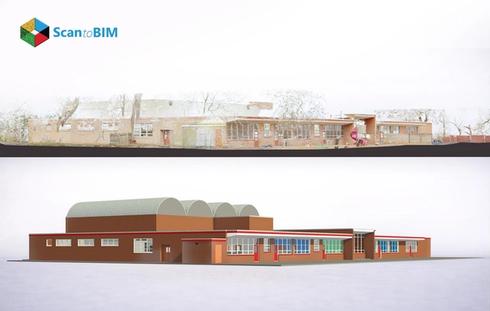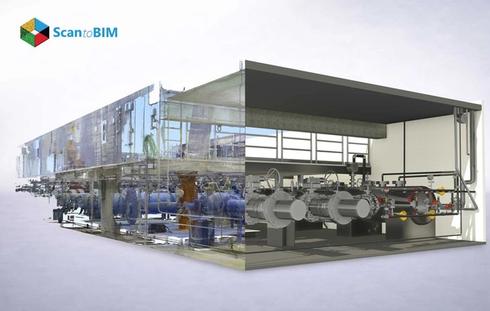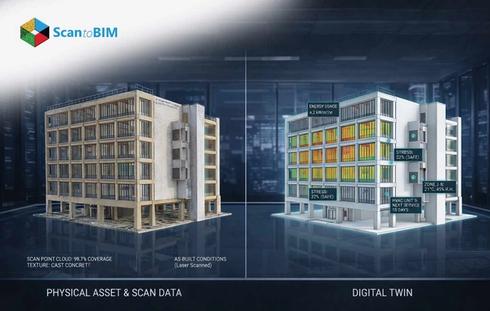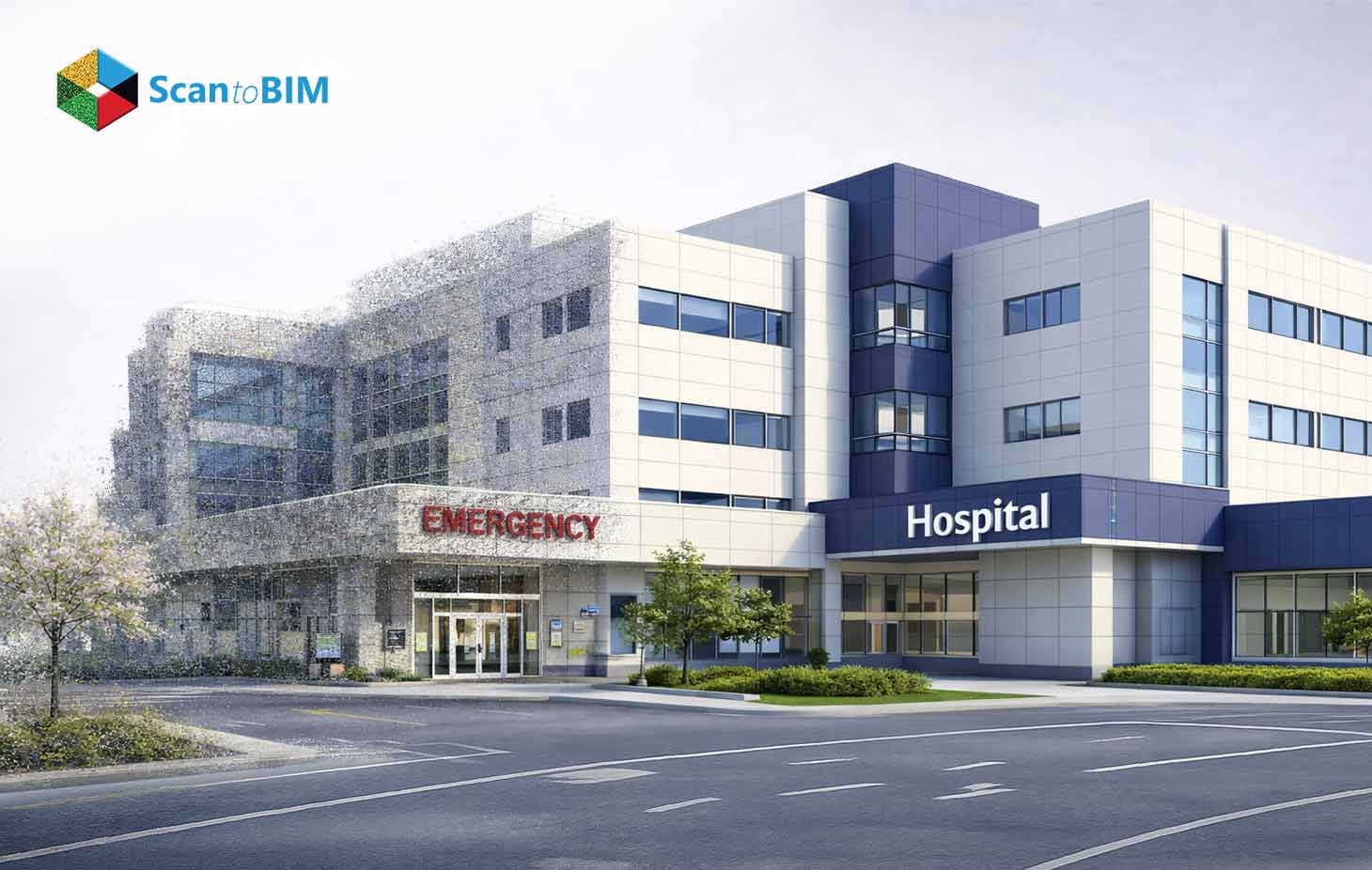
Life-critical environments demand the highest standard of spatial accuracy before renovation decisions reshape hospital infrastructure. Point Cloud to BIM is a digital workflow that converts millions of spatial data points captured through LiDAR and photogrammetry technologies into intelligent BIM models that represent real-world hospital conditions with exacting fidelity.
Hospitals require continuous upgrades, expansions, and compliance-driven modifications, rendering traditional 2D drawings obsolete for high-stakes decision-making. The process begins with highly detailed data capture that documents both visible and concealed building elements in a single survey pass. These point clouds serve as a central model, eliminating dependency on outdated as-built drawings and manual field surveys.
In healthcare environments, facility managers gain access to detailed digital replicas of critical systems, HVAC ducting, medical gas, and electrical infrastructure through this transformation. The adoption of BIM in hospitals stems from the need for operational continuity, patient safety, and regulatory compliance. All of which demand unwavering spatial accuracy. Scan to BIM bridges the gap between physical infrastructure and digital intelligence, enabling data-driven decisions across the full lifecycle of the facility.
Why Hospitals Require Accurate BIM Models
Hospitals operate continuously around the clock, and every renovation decision carries risk for active clinical operations. Working with point cloud to BIM for hospitals gives project teams spatial data that reflects the true geometry of oxygen pipelines, vacuum systems, and emergency electrical networks. All require exact mapping to protect against life-threatening service disruptions.
Inaccuracies in BIM models carry severe downstream consequences: a misaligned wall, a miscalculated ceiling clearance, or an incorrect duct routing can trigger unplanned shutdowns of ICU ventilation or operating room airflow management systems. Accurate models confirm that medical equipment placement aligns with real-world constraints, including clearance zones, access corridors, and clinical workflow paths.
Healthcare facilities operate under strict fire safety, infection control, and pressure zoning codes. Demanding precise spatial data as their regulatory foundation. BIM models allow teams to attach asset metadata, warranty details, maintenance schedules, and manufacturer information directly to model elements, creating a queryable record for lifecycle planning. Point cloud data confirms that the BIM model reflects actual site conditions rather than engineering assumptions, reducing errors across every construction and renovation phase.
How Point Cloud to BIM Works for Healthcare Facilities
The workflow begins with capturing both interior and exterior geometry of hospital buildings using high-resolution laser scanners. Point cloud to BIM healthcare facilities projects frequently apply colorized scanning to improve presentation clarity and stakeholder communication during design reviews. After scanning, teams align multiple datasets through registration techniques target to target or cloud to cloud, using Leica Cyclone REGISTER 360 and FARO SCENE to merge and clean raw scan data.
Technicians remove noise generated by moving personnel, equipment carts, and temporary site objects, producing a clean dataset ready for modeling. The processed point cloud exports into formats including .RCP, .RCS, .E57, or .LAS for BIM software compatibility. Then, Autodesk Revit enters with project coordinates, levels, and units fully configured.
Following the structured point cloud to BIM workflow, teams convert point cloud geometry into parametric BIM elements, structural, architectural, and MEP components according to project-specific LOD requirements. Quality checks include deviation analysis, clash detection through Autodesk Navisworks, and model validation against the original scan data. Final deliverables encompass Revit models, IFC files, 2D construction drawings, and coordination models distributed to all project stakeholders.
Role of 3D Laser Scanning in Hospital Environments
3D laser scanning captures millions of data points representing walls, ceilings, equipment, and MEP systems with millimeter-level accuracy. For scan to BIM for healthcare facilities this technology enables data collection in sensitive clinical zones, ICUs, operating theaters, radiology departments, and sterile corridors with zero disruption to patient care activities.
LiDAR-enabled scanning reaches concealed or hard-to-access building areas, including ceiling voids and service shafts, documenting infrastructure that traditional survey methods would miss entirely. Project teams select between mobile mapping systems and terrestrial scanners depending on floor plate geometry, building scale, and site accessibility constraints. The scanning process documents dense MEP networks with the spatial accuracy needed for coordination and future infrastructure upgrades. The resulting point cloud becomes the source data for creating digital twins of healthcare facilities, virtual replicas that simultaneously serve planning, renovation, and ongoing facility operations.
Benefits of Point Cloud to BIM for Hospitals
- 20% Reduction in project timelines with BIM adoption: Discover Materials, 2025
- 10–20% Annual operational cost savings via BIM digital twins in hospitals: Industry Analysis, 2025
- 72.98% Engineering project management efficiency improvement with BIM: ACM Conference, 2024
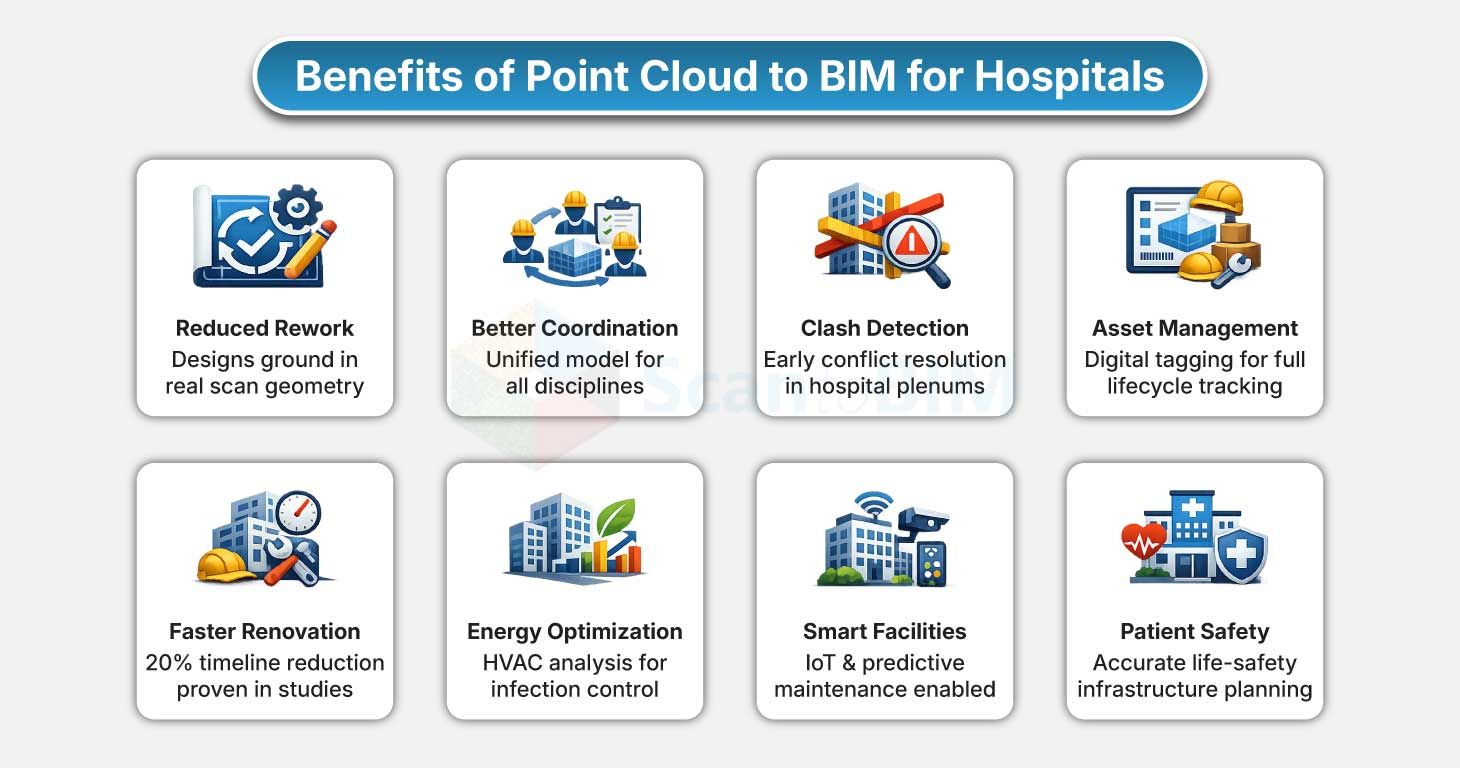
Accessing specialized point cloud to BIM services delivers these proven outcomes directly to hospital projects. Scanned models eliminate the guesswork that drives field rework, reduce construction risk through early clash detection, and give facility managers detailed asset data for planned maintenance cycles. BIM models support energy analysis and HVAC optimization, both critical for infection prevention in clinical environments. Hospitals couple these models with IoT systems to activate predictive maintenance and smart facility management, enhancing patient safety through accurate planning of emergency exits, ventilation systems, and life safety infrastructure.
Applications in Hospital Renovation and Facility Management
Point cloud to BIM for hospital renovation begins with accurately mapping existing conditions, such as walls, structural members, MEP distribution, and ceiling heights, before any design documentation starts. Space planning teams use BIM models to optimize patient room configurations and medical area layouts. They make utilization decisions based on actual floor geometry instead of outdated drawings.
Asset tracking becomes actionable once equipment and systems receive digital tags within the BIM environment, with maintenance teams accessing exact location, specification, and service history data on demand. Hospital renovation planning improves significantly when teams can visualize how proposed changes interact with existing infrastructure. They can identify coordination conflicts in the model before they occur on-site. BIM supports emergency response planning by providing accurate floor layouts for evacuation routes and life safety system placement.
IoT integration feeds real-time monitoring data from HVAC, lighting, and security systems into a centralized dashboard, turning the BIM model into an active operations tool. Predictive maintenance strategies reduce unplanned clinical downtime by identifying potential equipment failures ahead of impact. Digital wayfinding solutions grounded in accurate BIM geometry improve patient and visitor navigation through complex multi-wing hospital campuses.
Facility lifecycle management gains long-term value through regularly updated BIM models that capture every renovation, equipment replacement, and system modification. This creates a living infrastructure record for the building’s entire operational life.
Challenges in Healthcare Scan to BIM Projects
Large point cloud datasets demand structured data management strategies; projects lacking proper workflows experience processing and modeling slowdowns that extend delivery timelines. Registration accuracy depends on adequate overlap between scan positions; sparse coverage produces merged datasets with spatial errors that propagate through the BIM model.
Raw scan data from hospital environments contains noise from moving medical personnel, equipment carts, and temporary fixtures. All require extensive cleaning and preprocessing before modeling can begin. Accessing scan to BIM services from experienced providers helps project teams work within the strict accessibility constraints that active clinical facilities impose, including restricted zones, infection control protocols, and continuous patient operations.
Coordination across multiple stakeholders and technical disciplines adds project management complexity, and modeling MEP systems at healthcare-grade accuracy demands specialized skills and validated workflows. Data security and confidentiality governance add a unique layer of oversight in the healthcare sector. Strict regulatory compliance standards also increase the level of validation required at every project stage.
MEP Coordination and Complexity in Hospital BIM Models
Hospital MEP systems represent some of the most intricate building service networks in any built environment: medical gas pipelines, pressurized HVAC systems, isolated electrical circuits for life-critical equipment, and fire protection systems all share the same ceiling plenum. Accurate modeling of these interconnected systems is essential for functional safety and regulatory approval of any renovation or new construction scope.
Clash detection carries exceptional weight in hospital environments because ceiling voids and service shafts offer limited routing space; coordination errors discovered on site rather than in the model carry severe cost and schedule consequences. Coordination among disciplines requires a Common Data Environment for real-time collaboration. Tools such as StreamBIM provide centralized issue tracking, task management, and cross-discipline communication on a single platform. Real-time dashboards and structured digital workflows improve project transparency and accelerate resolution of coordination conflicts throughout execution.
Healthcare infrastructure modeling at this level of MEP density demands that every air change rate, pressure differential, and exhaust route receives accurate digital representation. These parameters govern infection control outcomes directly in operating rooms and isolation wards.
Accuracy and LOD Requirements for Healthcare BIM
Following the defined LOD in scan to BIM framework, healthcare projects require LOD 300 through LOD 500, depending on discipline and project phase. LOD 400 models carry fabrication details that direct construction teams and medical equipment planners with exact dimensional data for clearances and access paths.
| LOD | Key Characteristics | Healthcare Application |
|---|---|---|
| LOD 300 | Accurate geometry, quantity, and orientation | General architectural and structural coordination |
| LOD 350 | System interfaces and connections defined | MEP clash detection and space planning |
| LOD 400 | Fabrication-level detail, exact dimensions | Medical equipment clearance, duct fabrication |
| LOD 500 | As-installed, field-verified conditions | Facility management and asset registry |
Accuracy tolerance in healthcare BIM holds at ±10 mm, a threshold that supports safe medical equipment placement and dense MEP coordination across ceiling plenums. Deviation analysis compares the completed model against the source point cloud, confirming spatial fidelity across every floor and mechanical level. Compliance with ISO, AIA, and ANSI standards maintains consistent quality benchmarks across all project deliverables. High LOD models also support detailed asset management and facility operations from the day of handover.

Best Practices for Point Cloud to BIM in Hospitals
High-quality scanning equipment produces the accurate, detailed point cloud data that all downstream modeling depends on, making equipment selection the first critical project decision. Scanning teams plan scan positions to achieve adequate overlap, reducing registration error risk before data processing begins. Preprocessing workflows, noise removal, and data isolation protect modeling accuracy and reduce cleanup time for the BIM team throughout the project.
Within Revit, section boxes and visibility controls allow modelers to isolate specific floors or zones, managing large healthcare datasets at full processing speed. Targeted scoping, working only on the zones required for the current project phase, optimizes both time and resource allocation. Scheduled quality checks and deviation validation throughout the modeling process catch discrepancies early. Before they compound into costly corrections at handover. Automation tools and dedicated modeling plugins accelerate routine tasks, and clear communication protocols among all project stakeholders keep coordination aligned from scanning day through final model delivery.
Cost Considerations for Healthcare BIM Projects
Initial project costs cover laser scanning, data processing, and BIM modeling services. An investment that hospital owners should evaluate against the full financial picture of the renovation lifecycle. Accurate models improve cost estimation and budgeting accuracy, reducing the financial risk of scope surprises during active construction. Fewer required site visits and the elimination of manual survey campaigns lower total project expenditure from project initiation.
Improved cross-discipline coordination reduces costly construction-phase errors and protects project contingency budgets from avoidable change orders. Over the building lifecycle, structured maintenance planning and asset management generate ongoing savings that return multiples of the initial scanning and modeling investment. Research-documented outcomes a 15% construction cost reduction and 10–20% annual operational savings in hospital environments, frame the financial case for healthcare BIM investment with measurable, peer-reviewed evidence.
Choosing the Right Point Cloud to BIM Service Provider
Healthcare projects demand specialized expertise in medical infrastructure, life safety systems, and compliance standards qualifications that differentiate purpose-built healthcare BIM teams from generalist AEC providers. A proven provider demonstrates direct experience handling complex MEP systems and the unique operational constraints of active hospital environments, with documented workflows for working in sensitive clinical zones.
Advanced software platforms, quality assurance processes, and deviation reports form the technical backbone of an accurate and audit-ready deliverable. The right partner supports multiple software standards and interoperability formats, delivering models that work across the owner's entire project team without conversion friction. Client references from completed healthcare assignments and a portfolio of hospital projects provide the evidence base for a sound and defensible provider selection decision.
Conclusion
Point Cloud to BIM is reshaping healthcare facility management by delivering accurate, actionable digital models that hospitals can act on throughout their full operational life. Hospitals gain the capacity to operate efficiently, safely, and sustainably through improved planning, coordination, and maintenance. All grounded in spatial data that reflects actual building conditions.
The combination of scanning technologies, structured BIM workflows, and smart building systems creates healthcare infrastructure prepared for today's demands and tomorrow's requirements. As hospitals face growing infrastructure complexity and tightening compliance demands, Point Cloud to BIM stands as the most capable tool for managing that complexity and upholding the highest standards of patient care.