It’s important for businesses bidding to know that winning a government contract in the United States requires a strategic approach and not simply focusing on the lowest bid. Many Architecture, Engineering and Construction (AEC) firms have lost bids to incumbent bidders or low-bidder proposals that appear inferior to them on paper due to better pre-positioning, early intelligence, and precision in compliance with the submission process. Across all types of industries, the average RFP win rate is approximately 45%. Therefore, over half of qualified proposals will not win a contract even though they may have the technical capabilities to perform once awarded.
The real reasons firms lose are not technical capability, but:
- Failure to decode evaluation criteria before writing responses
- Compliance missteps that disqualify bids early
- Lack of strategic differentiation in positioning
This article will help you:
- Decode government RFPs
- Outmaneuver incumbents through proven competitive insights
- Price and position your value to win more government contracts
As a firm that has seen what actually wins, we share practical, data-backed strategies to elevate your bid success in federal, state, and local procurements.
What Is a Government RFP and Why AEC Firms Must Treat It Differently
What is a government RFP in construction, surveying, and AEC?
Federal, state, and local government agencies utilize Request for Proposal (RFP) as the formal, structured solicitation process when contracting for complicated services such as surveying, design, engineering, and construction. The RFP identifies the work to be performed i.e., the scope of work, the deliverables to be provided, the evaluation criteria, any compliance requirements, and the legal terms to which bidders must comply. A government-issued RFP also requires bidders to provide an extensive amount of background information to support their responses, including detailed documentation of their technical capabilities and ability to fulfil the requirements in the RFP. In general, successful responses demonstrate the technical capabilities of the proposer as well as the ability to comply with the agency’s procurement regulations.
How Public RFPs Differ from Private-Sector Bids - Public RFPs Vs. Private Bids
| Public (Government) RFPs | Aspect | Private-Sector Bids |
|---|---|---|
| Defensible, auditable decision that can survive scrutiny | Primary Goal | Best commercial outcome for the owner |
| High. Scope, criteria, and often award details are public | Transparency | Limited. Decision logic is rarely disclosed |
| Mandatory and unforgiving. One missed form can disqualify a bid | Compliance | Flexible. Issues can be clarified or negotiated |
| Published, weighted criteria (MEAT) | Evaluation Method | Ranges from formal scorecards to subjective |
| Weighted with technical merit, risk, and past performance | Price Role | Often dominant or negotiated late |
| Structured, written-only through formal Q&A | Communication | Direct conversations and informal clarifications |
| Low. Agencies favor predictable, low-risk delivery | Risk Tolerance | Higher. Owners may accept innovation or ambiguity |
| High. Every decision must withstand audits and protests | Audit & Protest Risk | Minimal. Awards are rarely challenged |
| Evidence-driven, methodical, evaluator-focused | Proposal Style | Persuasive, relationship-led, outcome-focused |
Federal vs State vs Local Government RFPs
| Aspect | Federal Government RFPs | State Government RFPs | Local Government RFPs |
|---|---|---|---|
| Typical Issuers | Federal agencies, DoD, GSA, USACE | State DOTs, transportation and infrastructure agencies | Cities, counties, utilities, transit authorities |
| Where They’re Posted | SAM.gov | State procurement portals, DOT websites | City or county eProcurement portals |
| Governing Rules | Federal Acquisition Regulation (FAR) | State procurement statutes and DOT manuals | Municipal codes and agency-specific policies |
| Level of Standardization | Very high. Templates and clauses repeat across agencies | Moderate. Structure varies by state | Low. Formats and expectations vary widely |
| Compliance Burden | Heavy. Extensive forms, certifications, representations | Medium to high, depending on agency | Medium, often less documented but still strict |
| Evaluation Approach | Formal scoring with detailed documentation | Weighted technical and price scoring | Often committee-based with practical focus |
| Typical Contract Size | Large, multi-year, national or regional | Medium to large, statewide or corridor-based | Small to mid-sized, site or city-specific |
| Schedule Realism | Conservative, but inflexible | Aggressive, tied to funding cycles | Variable, often politically driven |
| Risk Tolerance | Very low. Proven methods and compliance favored | Low to moderate | Moderate, especially for trusted vendors |
| Strategic Fit for Surveying Firms | Best for firms with mature compliance systems and scale | Ideal for regional leaders with DOT experience | Strong entry point for relationship-led expansion |
Strategic takeaway for surveying firms:
- Federal RFPs reward process maturity and compliance discipline.
- State RFPs favor sector specialization and delivery track record.
- Local RFPs prefer responsiveness, familiarity, and execution certainty.
Where Large Surveying Firms Find High-Value Government RFPs in the U.S.
Primary Portals for U.S. Government RFPs
The onset of successful capture starts by having an understanding of where to find the best solicitations.
- Federal Opportunities at SAM.gov: You can find authoritative data set for federal procurement notices along with civil, transportation, geospatial, and construction contracting opportunities.
- State DOT Procurement Portals: As states spend billions on infrastructure, their Department of Transportation (DOT) posts "RFPs" for projects related to the overall statewide infrastructure program.
- eProcurement Systems of Cities & Counties: Many city or county-specific web portals manage local public works and survey jobs associated with urban redevelopment and utility upgrade projects.
- Web Portals for Utilities, Transportation, and Infrastructure: Some "RFPs" may be posted outside the broader procurement web portals; many high-value corridor and asset management-related projects are typically driven through these types of solicitation systems.
| Portal | Description |
|---|---|
| SAM.gov – Federal Contract Opportunities | Centralized federal procurement portal listing all active solicitations over $25,000. Primary source for federal surveying, infrastructure, and AEC RFPs. |
| SAM.gov Contract Opportunities Search | Direct interface to filter and find current federal RFPs by NAICS code, keywords, and agency. |
| GovernmentContracts.us | An aggregated list of federal, state, and local contract notices, including bids and RFPs across all 50 states. |
| Find RFP (Government Bid Source List) | Search engine for federal, state, and local government RFPs and bids sorted by state. |
| CivMetrics State & Local RFP Library | Filterable library of state and municipal construction and public works solicitations. |
Why early visibility matters more than proposal writing
Leading firms rarely wait for an RFP to hit the portal before they get serious. The real work starts much earlier.
- Capture planning happens before the solicitation shows up, when teams are still shaping strategy, deciding whether the opportunity is worth the effort, and identifying where they can realistically win
- Relationships are built long before the proposal is written, through industry days, pre-market outreach, and conversations that reveal what the agency is truly worried about delivering on
- Teaming and competitive intelligence develop early, helping firms validate assumptions, close capability gaps, and avoid blind spots that surface too late in the process
By the time the RFP is released, the winning teams are not scrambling to write. They are confirming a plan that is already in motion. In government pursuits, early positioning consistently outperforms last-minute proposal polish.
What Registrations and Certifications Do AEC Firms Need Before They Can Bid On Government Contracts?
Mandatory Registrations Before Bidding on Government Contracts
Many strong surveying firms lose government RFPs before evaluators ever read the technical section. The reason is simple and frustrating. Compliance is pass or fail. If your registrations are not active on the day of submission, the proposal is often rejected outright.
At a minimum, firms must have:
- An active SAM registration, required for all federal work and most federally funded state projects
- A valid UEI, now the single identifier used across federal procurement systems
- Completed state and local vendor registrations, which often control access to amendments and addenda
Administrative noncompliance is one of the leading causes of bid rejection in public procurement.
Certifications That Improve Scoring in the Public Sector RFPs
Certifications unlock set-asides and scoring advantages. The federal government sets goals to award at least 18% of prime contract dollars to small businesses each year, with targets for women-owned, disadvantaged, veteran-owned, and HUBZone firms. Agencies exceed these goals regularly, and partnering with certified small businesses can improve your proposal’s competitive positioning by aligning with agency socio-economic objectives.
Decode the RFP Like a Scoring Committee Member
Which Sections of Government RFP Matter Most?
Most firms read an RFP to understand what to write. Scoring committees read it to justify a decision. That difference matters. Evaluators spend most of their time moving between a few sections:
- Scope of work, where agencies reveal what they are truly worried about delivering
- Technical requirements, which expose tolerance for accuracy, data quality, and rework
- Evaluation criteria, the only place that legally explains how points are awarded
- Contract terms and risk clauses, which quietly flag schedule pressure and liability concerns
How to Quickly Decide If an RFP Is Worth Pursuing
Strong firms walk away early when the fit is wrong. Ask:
- Do we have directly comparable past performance?
- Can we deliver efficiently in this geography?
- Is the schedule realistic, not political?
- Does the fee cap match the risk?
If the answers feel forced, the pursuit probably is.
How to Read Evaluation Criteria to Reverse-Engineer The Win
Read evaluation criteria like an auditor:
- Weighting shows whether price or technical confidence drives selection
- Past performance often matters more than firms expect
- Social goals and risk reduction influence scores even when not obvious
Winning starts with understanding how evaluators think, not how proposals are written.
Outsmarting Competitors — Ethical RFP Hacks That Actually Work
Most firms assume government RFPs are won on credentials. In reality, they are won on how easy you make the evaluator’s decision.
What Winning Proposals Do Differently
High-performing firms write the proposal the way scoring committees read it.
- They mirror the evaluator’s language so reviewers can quickly connect responses to scoring criteria
- They show they understand agency risk, especially around data accuracy, downstream coordination, and schedule pressure
- They focus on reducing uncertainty, proving they have delivered this exact type of work before
The U.S. GAO notes that many bid protests stem from poorly supported evaluations, which is why defensible, clearly mapped responses consistently outperform impressive but vague proposals.
How Can Firms “Ghost” Competitors Ethically in Their RFP Questions Or Responses to Highlight Their Own Strengths?
This is not about trickery. It is about precision.
- Use the Q&A phase to clarify scope gaps that others miss
- Frame assumptions around workflows where your team is already strong
- Call out known risks early and show how you manage them
Evaluators start comparing firms through the lens you set.
How Can an Incumbent Be Outcompeted on a Re-Compete Contract in Design, Engineering, or Construction Services?
Incumbents lose when familiarity turns into complacency.Challengers win by:
- Improving processes that reduce rework
- Offering credible schedule certainty
- Demonstrating tighter data quality and QA/QC controls
On re-competes, agencies choose the firm that feels safer to defend, not the one that feels familiar.
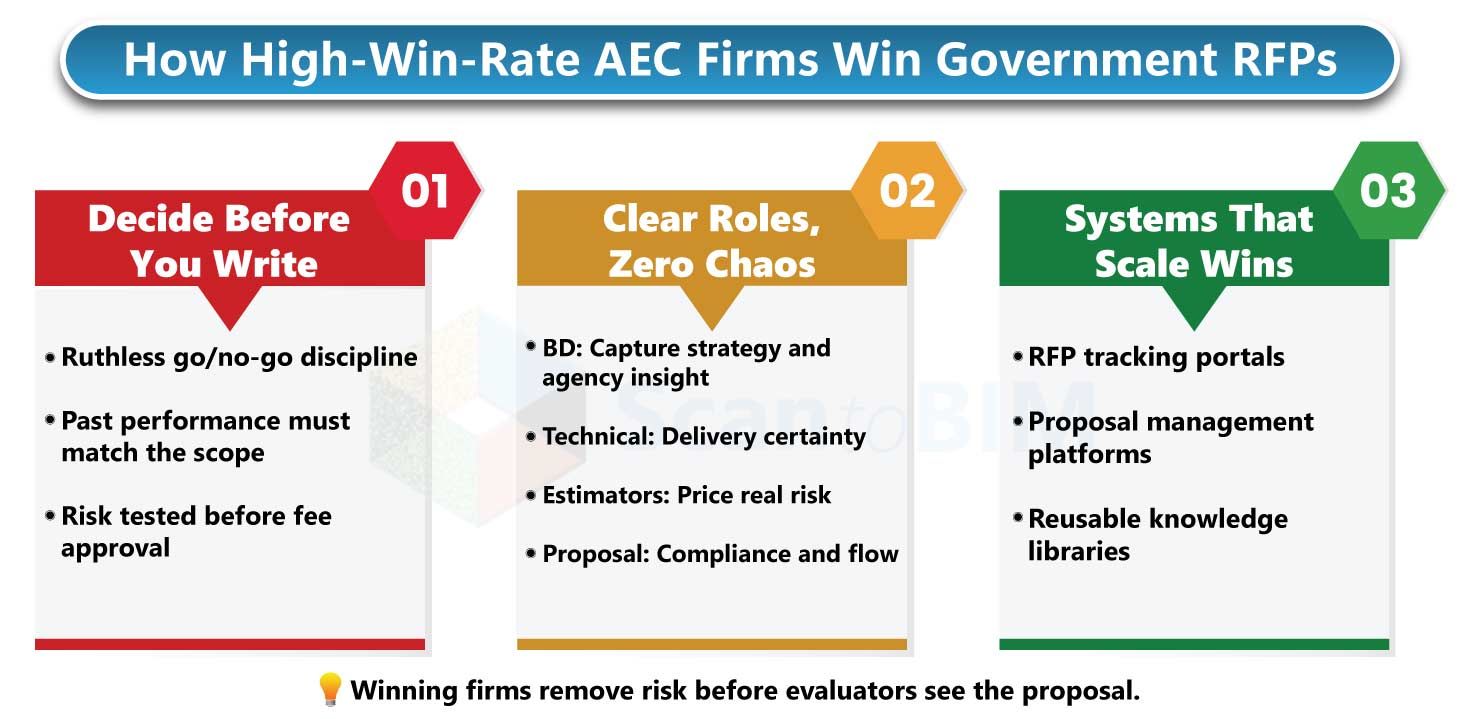
Internal RFP Processes Used by High-Win-Rate AEC Firms
High-win-rate AEC firms do not rely on last-minute heroics. Their advantage comes from calm, repeatable internal systems that remove guesswork from pursuits.
Capture Planning and Review Gates
Before a single page is written, strong firms pause and ask hard questions. The go or no-go decision is treated as a business risk filter, not a morale discussion. If the scope stretches past proven experience, the geography strains delivery, or the risk profile feels misaligned, they step away early. For viable pursuits, a pink team review shapes the story from an evaluator’s point of view, while a red team review later stress-tests compliance, clarity, and scoring logic. This discipline protects margins and credibility.
How Should Roles Be Split Between BD, Technical Leads, Estimators, And Proposal Writers on A Government Pursuit?
Winning firms avoid blurred responsibilities.
- Business development owns capture intelligence and agency relationships
- Technical leads convert scope into methods that feel safe and executable
- Estimators price risk realistically instead of optimistically
- Proposal managers guard compliance, deadlines, and evaluator flow
Everyone knows their lane, which reduces rework and late surprises.
Which Digital Tools or Platforms Help Track Government RFPs and Manage Responses for AEC Companies?
High performers lean on:
- Tracking portals to spot opportunities early
- Proposal management platforms to control versions and workflows
- Knowledge libraries that store scored content and lessons learned
Tools do not win RFPs, but they prevent avoidable losses.
What Happens After Submitting Government RFPs and How Winners Learn Faster
Submission is rarely the end. For experienced firms, it is the beginning of feedback.
Post-Submission Stages Explained – Government Contracts
Most government pursuits move through shortlisting, interviews, BAFO, and negotiations. Firms that prepare for these stages early present consistent answers, defend assumptions clearly, and project delivery confidence. Those who do not often unravel under questioning.
How Can AEC Firms Request and Use Debriefs To Improve Win Rates On Future Government Contracts?
Debriefs are where real learning happens. Instead of asking why they lost, winning firms focus on how evaluators interpreted risk, relevance, and clarity. Patterns quickly emerge. A method that sounded strong internally may score weak externally. Over time, this insight reshapes how future proposals are framed.
How Should Firms Build A Case-Study and Knowledge Base From Won/Lost Government Proposals?
Smart firms document:
- Reusable technical insights
- Scoring trends by agency
- Preferences around schedule, QA/QC, and reporting
Losses become data, not disappointment.
Conclusion: Government RFPs Are a Strategy Game, Not a Writing Exercise
Most firms lose government contracts before the proposal is ever written. They react too late, underestimate risk, or assume experience alone will carry them. Firms that win consistently think differently. They invest in early intelligence, read RFPs like evaluators, and design proposals to reduce fear, not just explain scope. For large surveying firms, success is not about chasing every opportunity. It is about preparing quietly, choosing carefully, and showing agencies that selecting you is the least risky decision they can make.