Construction teams across the US are adopting AI for scheduling, risk forecasting, and progress tracking. Many of these tools produce confident answers that do not match what is happening on site. The issue is usually not the AI model. The issue is the data behind it.
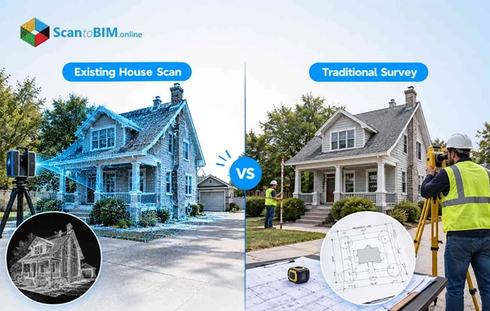
Historical schedules and design drawings describe intent, not current conditions. Existing buildings diverge from their record drawings after years of undocumented changes. Renovation and infrastructure teams feel this gap the most, since incomplete documentation raises risk at every planning stage.
Scan to BIM closes this gap. It converts measured site conditions into structured, spatially accurate model data that AI systems can classify and learn from. For hospitals, data centers, and industrial facilities, this connection decides whether AI recommendations can be trusted.
What Is AI-Driven Construction Planning?
Autodesk and FMI estimated that bad project data cost the global construction industry close to $1.85 trillion in 2020. That data-cost figure explains why owners are investing in better information systems before adding AI on top. AI-driven construction planning applies machine learning, computer vision, and optimization methods to decisions like sequencing, scheduling, resource allocation, and site logistics.
Traditional planning relies on work breakdown structures, duration estimates, and critical path scheduling. Planners build these manually and update them from field reports. This method still works, but it struggles with the sheer number of variables on a large project.
AI extends this practice rather than replacing it. Depending on the task, an AI system may perform:
- Descriptive analysis - Identifying what has been installed and where
- Diagnostic analysis - Finding probable causes of delays or clashes
- Predictive analysis - Estimating the probability of delay or cost growth
- Prescriptive analysis - Recommending alternative sequences or crew allocations
- Generative assistance - Drafting look-ahead plans or summarizing coordination issues
A 2025 Dodge Construction Network study of nearly 200 US owners found that 28 percent were already using AI and 18 percent were using digital twins. Owners who treated their data as a strategic asset reported more reliable cost and schedule outcomes than owners who did not.
Why Accurate BIM Data Matters for AI
That data-cost figure explains why BIM for construction planning needs accurate inputs before AI adds any value. AI does not correct unreliable information on its own. A model with misplaced objects or outdated geometry produces answers that sound confident but are wrong.
The calculation of a crane reach requires reliable dimensions.A clash prioritisation model must take into account system type and clearance requirements, not just intersecting geometry.
Here accuracy is multidimensional:
- Geometric accuracy is the degree to which elements match measured position and orientation
- Completeness ensures required space and systems are captured
- Semantic correctness checks that objects are of the right classes and of the right system
- Topological correctness checks that connections and adjacencies are modelled correctly
- Temporal currency means a known date of capture.
- Traceability links items back to source scans and revisions
The BIMForum's Level of Development framework tells teams what to depend on. LOD 300 elements carry measurable size and location. LOD 350 adds measurable interfaces with adjacent components. Development level is not the same as measured accuracy.
These dimensions only matter if the capture process feeding them is disciplined.
How Scan to BIM and AI Work Together
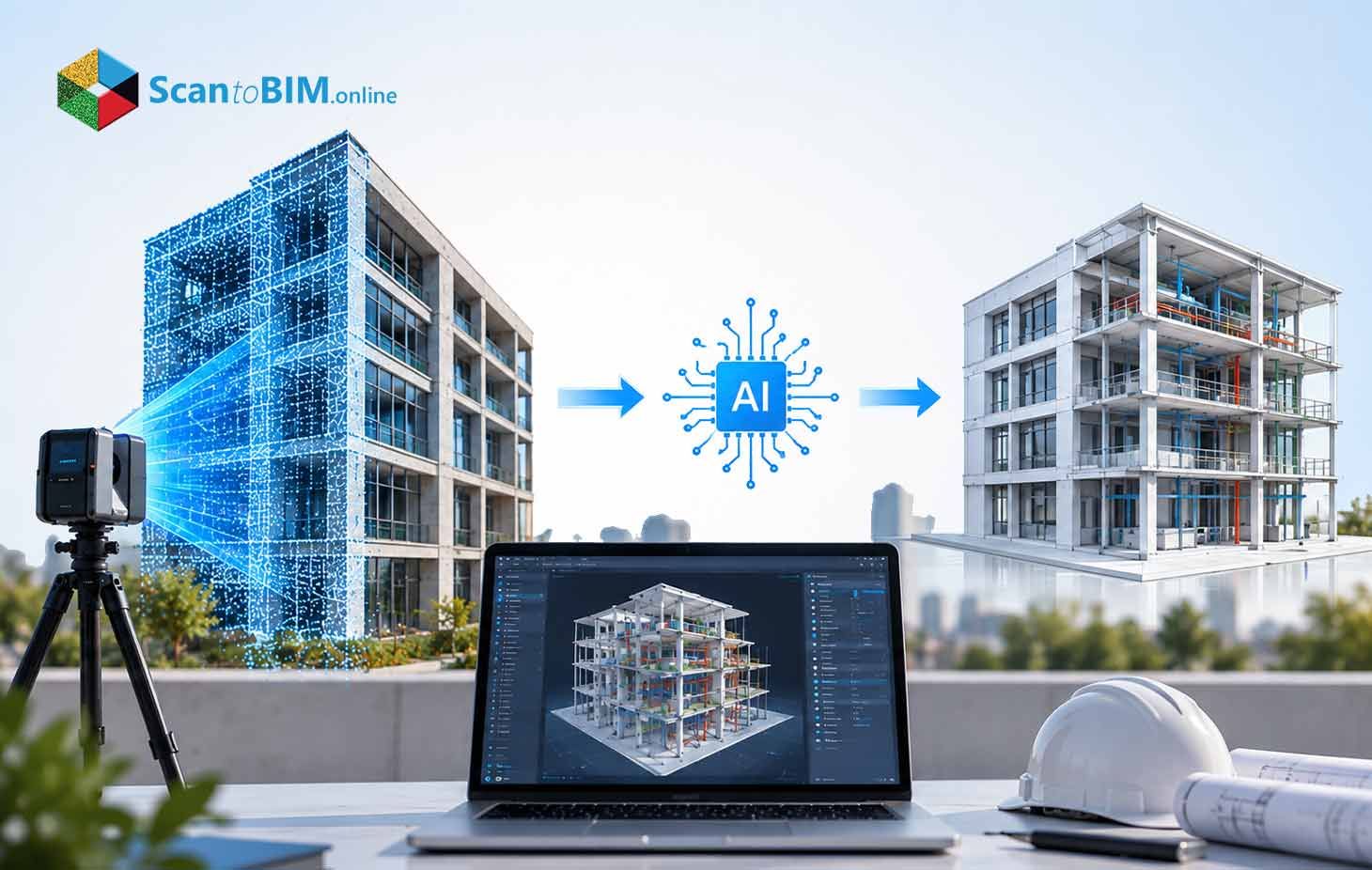
Scan to BIM and AI support each other in two directions. AI can automate parts of the modeling workflow itself. The resulting model then becomes an input for construction-planning AI further downstream.
In an AI-powered scan to BIM workflow, computer vision classifies point cloud regions and suggests matching BIM families. Human modelers then review conditions the software cannot resolve safely.
Research shows real progress here. One structural digital-twin study reported 89 percent identification accuracy. A bridge study reported 88.45 percent mean segmentation accuracy before parametric modeling began.
Once validated, the model becomes AI-readable evidence of the jobsite. Repeated capture over time supports programs that track a building continuously, since Digital Twin construction depends on ongoing updates, not a single snapshot.
This creates a loop: capture reality, build the model, run AI analysis, review, execute, then capture again.
Scan to BIM Workflow for AI-Ready Construction Data
Building that loop starts with defining what the model needs to support before any scanning begins, since this is what makes BIM for construction planning genuinely useful downstream. Possible uses include MEP coordination, sequencing, progress monitoring, or digital-twin initialization.
A disciplined workflow for scan to BIM automation generally follows these steps:
- Specify information requirements - Coordinate systems, object classes, accuracy targets, and naming conventions
- Plan and conduct reality capture - Select terrestrial scanners, mobile mapping, or drones based on site conditions
- Register and preprocess data - Align scans, remove noise, and preserve the raw source files
- Segment and classify point clouds - Apply deep learning to separate walls, ducts, pipes, and equipment
- Reconstruct BIM objects - Convert classified data into parametric or surface-based elements
- Enrich model semantics - Add classification codes, system data, and connectivity information
- Validate and approve - Check registration, coverage, and attribute completeness before release
- Publish controlled data - Move approved models into a shared environment with revision control
The National BIM Standard-United States Version 4 gives scan to BIM in USA projects a consensus framework for defining these requirements contractually. IFC 4.3, published as an ISO standard in 2024, extends open data exchange into roads, bridges, and other infrastructure types. This step alone does not produce a scan to BIM for digital twin program, but it builds the geometric foundation such programs require.
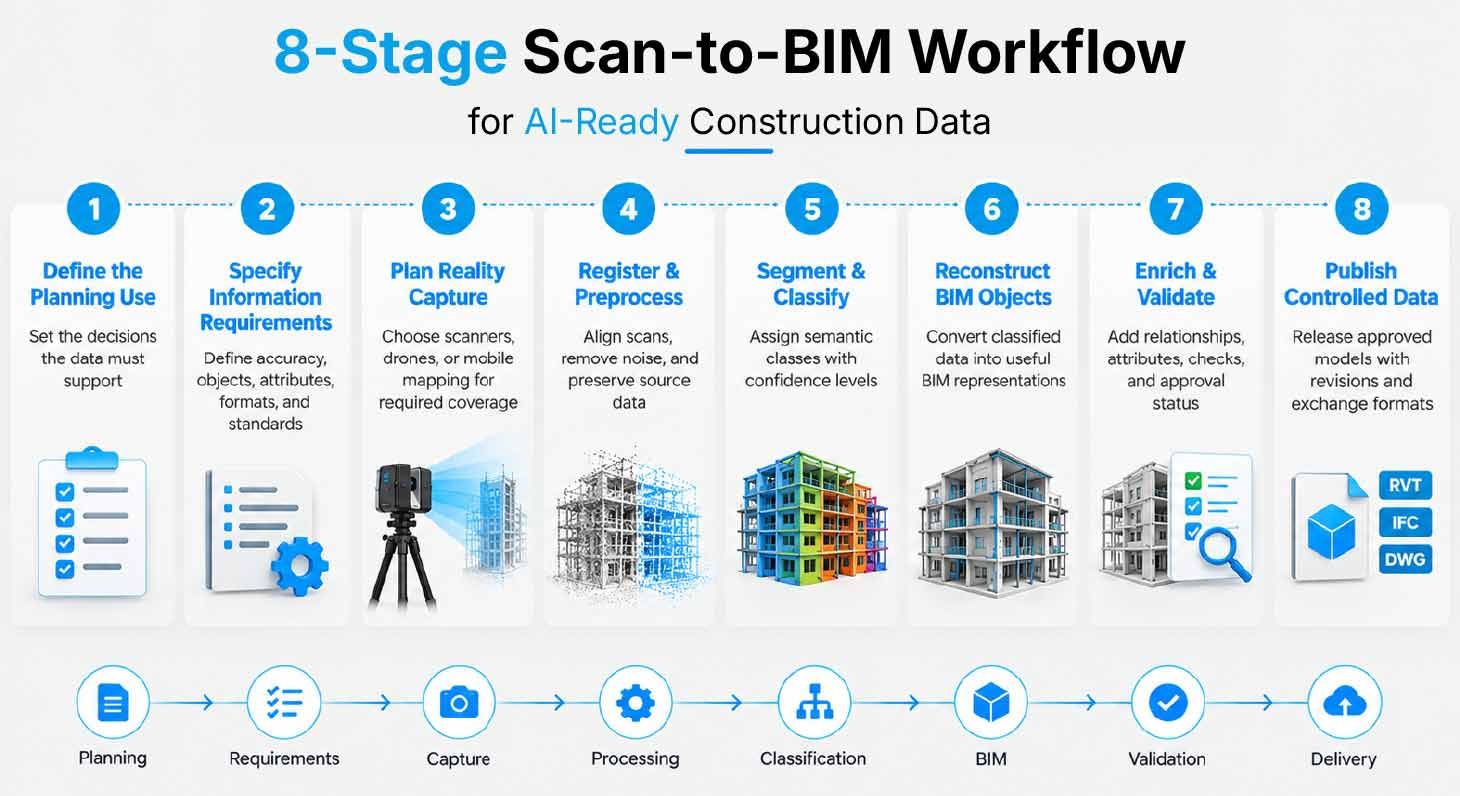
Point cloud to BIM services become genuinely useful for AI when this workflow treats classification and metadata as seriously as geometry. A model built this way is ready for the analysis stage that follows.
How AI Can Analyze BIM and Reality-Capture Data
With a validated model in place, AI can analyze construction reality capture data at several levels at once.
- Geometric analysis measures distances, clearances, and deviations between planned and observed conditions.
- Semantic analysis tells the system what an object represents because a pipe and a cable tray can look similar but follow different rules.
- Relational analysis considers adjacency and connectivity. It confirms if an equipment route goes through a narrow door or if a shutdown affects assets that are interconnected.
- Temporal analysis compares scans from different dates, and correlates installed status with scheduled activities.
AI becomes more useful still when this geometric data connects with schedules, cost codes, daily reports, and procurement records. The model supplies the spatial index, while other project data attaches to specific rooms, systems, or work packages. This layered analysis is exactly what makes AI-powered clash detection more precise than older, geometry-only methods.
AI-Powered Clash Detection and Coordination
Traditional clash detection applies geometric rules to federated models and flags every intersection, including many that do not matter. AI changes this process in four ways.
- Prioritizes clashes by likely cost, schedule impact, and fabrication status
- Groups related clashes into a single root-cause issue instead of many duplicates
- Recommends resolution strategies based on system hierarchy and project rules
- Compares design intent against physical reality, not just design against design
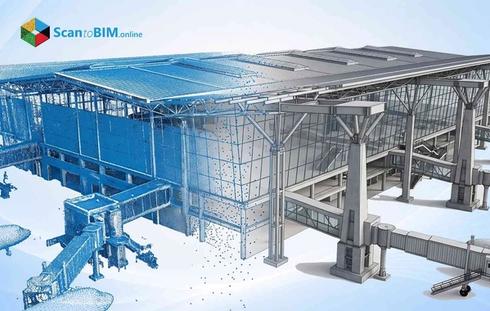
That comparison depends entirely on construction reality capture. Design-to-design clash detection cannot reveal that an existing beam is positioned outside its documented location. Overlaying design models with registered point clouds exposes these conditions before installation begins.
LOD 350 is particularly relevant here, since it includes measurable interfaces with adjacent elements, which supports clash resolution around supports and penetrations. For hospitals, laboratories, and data centers, this reality-based coordination matters because live systems and tight installation windows raise the cost of any mistake.
Clash detection is one output of this data. The same reality-based model also feeds risk and schedule forecasting, which is where AI construction planning shows its broadest impact.
AI for Construction Risk and Schedule Analysis
Clash detection protects individual installations, but schedule and risk models protect the project timeline as a whole. AI schedule analysis uses project data to estimate durations, detect abnormal trends and predict delay probability.
A 4D workflow links BIM objects to schedule activities. Periodic reality capture then lets algorithms estimate which objects are present, partially complete, or displaced, and compares that status against the baseline schedule. This helps answer practical questions:
- Is a zone complete enough for the next trade to begin?
- Are predecessor activities advancing at the assumed rate?
- Which work packages are likely to miss their handoff dates?
- Where are material or access constraints building up around critical work?
Reported results vary by dataset and project type. A 2026 study using real time data from 68 projects reported 95.56 percent accuracy for a hybrid delay prediction model. A separate study reported 74.07 percent accuracy for its best model. That shows how much performance depends on context.
These forecasting and safety gains lead directly to the broader business case for adopting this approach on US projects.
Benefits of Scan to BIM for U.S. Construction Projects
That business case becomes concrete once the gains are broken down by project type, showing exactly where BIM for construction planning pays for itself. The value shows up across several areas at once:
- Better renovation planning: Measured geometry replaces incomplete or obsolete record drawings
- More reliable coordination: Reality-based models catch conflicts between new design and existing conditions early
- Objective progress evidence: Time-stamped construction reality capture supplements subjective percentage-complete reporting
- Improved prefabrication confidence: Dependable interface dimensions support piping spools and facade panels
- Stronger schedule forecasting: Observed production feeds forecasting models instead of assumptions alone
- Safer logistics planning: Reality-based models represent access routes and laydown areas before crews mobilize
Scan to BIM projects in USA deliver the most value in occupied buildings, hospitals, airports, and industrial facilities, where hidden conditions and limited access can lead to expensive field changes. These are also the project types where the data-cost figures cited earlier hit hardest.
These benefits assume the underlying workflow is done well. The next section looks honestly at where the approach still runs into real limits.
Challenges and Limitations of AI-Powered Scan to BIM
Those limits start with a basic fact about the technology. A point cloud captures visible surfaces, not everything inside a wall or behind a ceiling. Concealed reinforcement, hidden systems, and inaccessible areas may still require drawings, inspection openings, or sensors.
Several other constraints apply in practice:
- Occlusion from workers, materials, and scaffolding blocks the scanner's view on active sites.
- Scan to BIM automation still struggles with irregular geometry, unusual object types, and scene complexity.
- Labeled training data remains expensive to create and may not reflect US project conditions.
- Interoperability between BIM tools, point cloud platforms, and AI pipelines can still lose information.
- Large datasets require meaningful storage, processing time, and network capacity.
- Excess modeling detail can add cost without improving planning outcomes.
- AI output is decision support, not a professional determination on its own.
Digital Twin construction adds another layer of complexity, since governance and update frequency both need clear ownership. Reality capture data can reveal secure rooms or operational systems, which raises real questions about permissions and retention.
A 2024 review of deep learning for construction point clouds found that performance remained limited for several tasks, particularly segmentation accuracy, and identified generalization and data availability as ongoing issues.
None of this argues against the approach. It argues for treating AI recommendations as inputs to professional judgment, not replacements for it. With that caveat in place, it is worth looking at where this combination is headed next.
The Future of AI-Driven Construction Planning
AI-powered scan to BIM will increasingly use foundation models trained on larger collections of three-dimensional data, reducing the need to train a new classifier for every object category.
- Multimodal AI will combine point clouds, BIM, drawings, and schedules into a single reasoning layer.
- A planning assistant could identify a progress anomaly geometrically, then retrieve the related activity automatically.
- Graph-based BIM intelligence is also gaining ground, since buildings are relational systems where pipes connect to equipment and activities depend on predecessor work.
- Scan to BIM for digital twin programs will likely extend further into infrastructure, supported by IFC 4.3's coverage of roads and bridges.
Human-in-the-loop review will remain the most credible model for now.
Conclusion
Scan to BIM gives AI-driven construction planning something it cannot generate on its own: a measured, current picture of what actually exists on site. Point clouds supply dense geometric detail, while the resulting model adds classification, relationships, and links to schedule data.
The value is strongest on renovation, healthcare, industrial, and infrastructure projects, where undocumented changes and limited access raise the cost of every mistake. Getting there requires more than buying a scanner or subscribing to an AI platform. Teams need defined information requirements, disciplined capture, careful validation, and professionals who review results before they reach the field.
The strongest version of this process is a loop: measure the site, structure the data, analyze it, get professional approval, build, then measure again. That loop is what makes AI recommendations worth trusting on a US construction project.